Two overviews, if you would rather see the argument before reading it
The first sets up the problem. The second presents the model. The full case study follows below, and nothing in the videos replaces it.
Start here
Demystifying Dolby Atmos Height Panning
Why height information collapses toward the ear level speakers when an immersive mix is folded down, and what that does to the perceived width of a source that was never wide.
Video overview generated with Google NotebookLM from the author's case study.
The model
The Trapezoidal Panning Approach
The proposed model itself: a panning domain whose permissible lateral extent is constrained as a function of elevation, so that elevation stops producing width it was never meant to produce.
Video overview generated with Google Gemini Notebook from the author's case study.
On how these were made. The trapezoidal model, the written case study and all thirty figures on this page are the author's own work. The two video overviews above were assembled from that written material using Google's notebook tools, and carry those tools' watermarks.
Immersive audio has spent years moving toward increasingly sophisticated representations of three-dimensional space.
The underlying visual metaphor is usually attractive and intuitive: a listener sits at the center of a three-dimensional environment, loudspeakers surround the listener, and a sound can theoretically be positioned anywhere within that environment.
But there is a fundamental question that deserves much more attention:
Does a mathematically available position necessarily represent a perceptually correct position?
This case study proposes that it does not.
The Trapezoidal Panning approach presented here begins with the observation that spatial position, perceived width, speaker geometry, translation and human perception are not interchangeable variables.
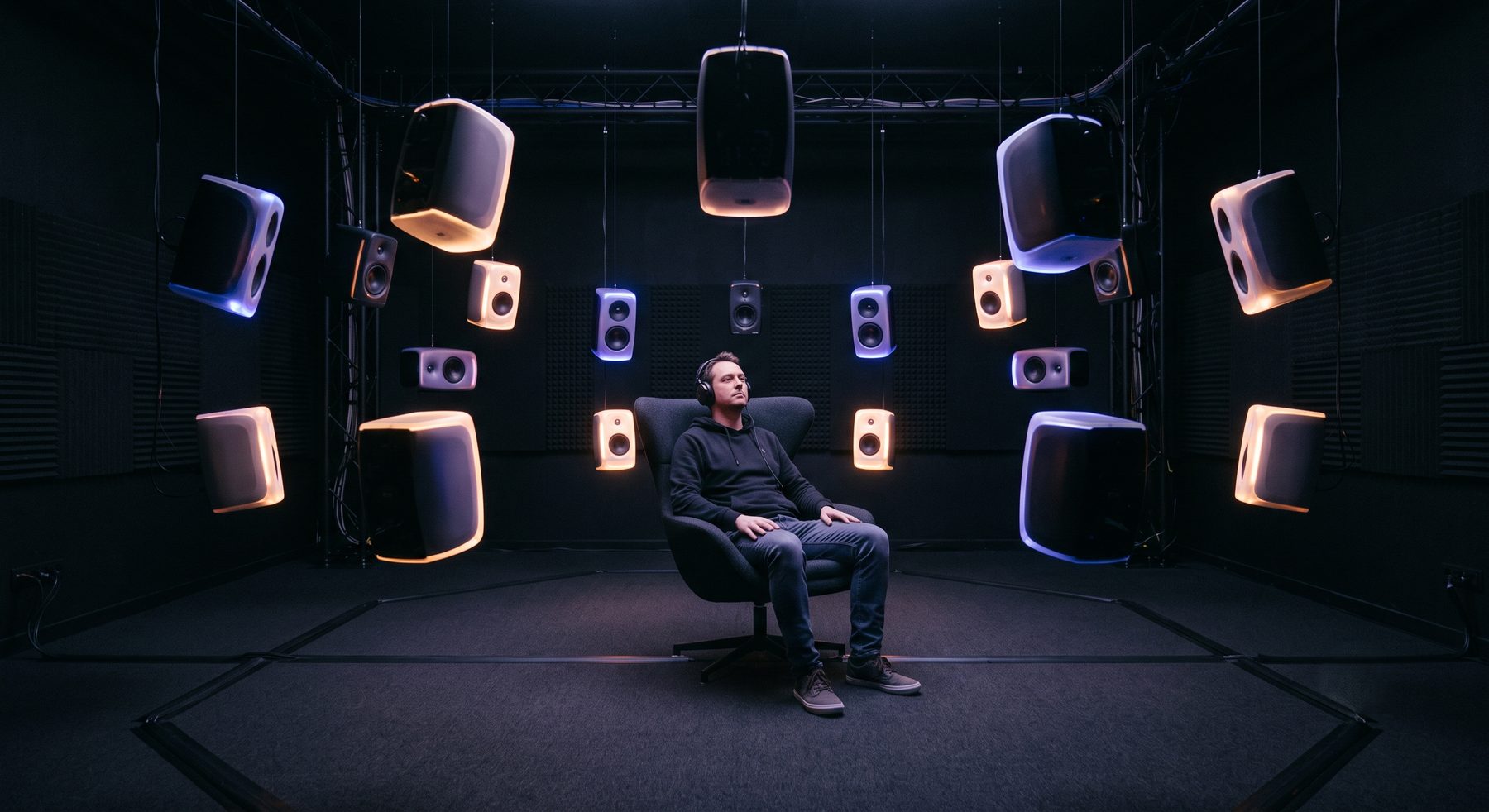
In particular, elevated content should not automatically become wider when it is translated into a lower-dimensional reproduction system.
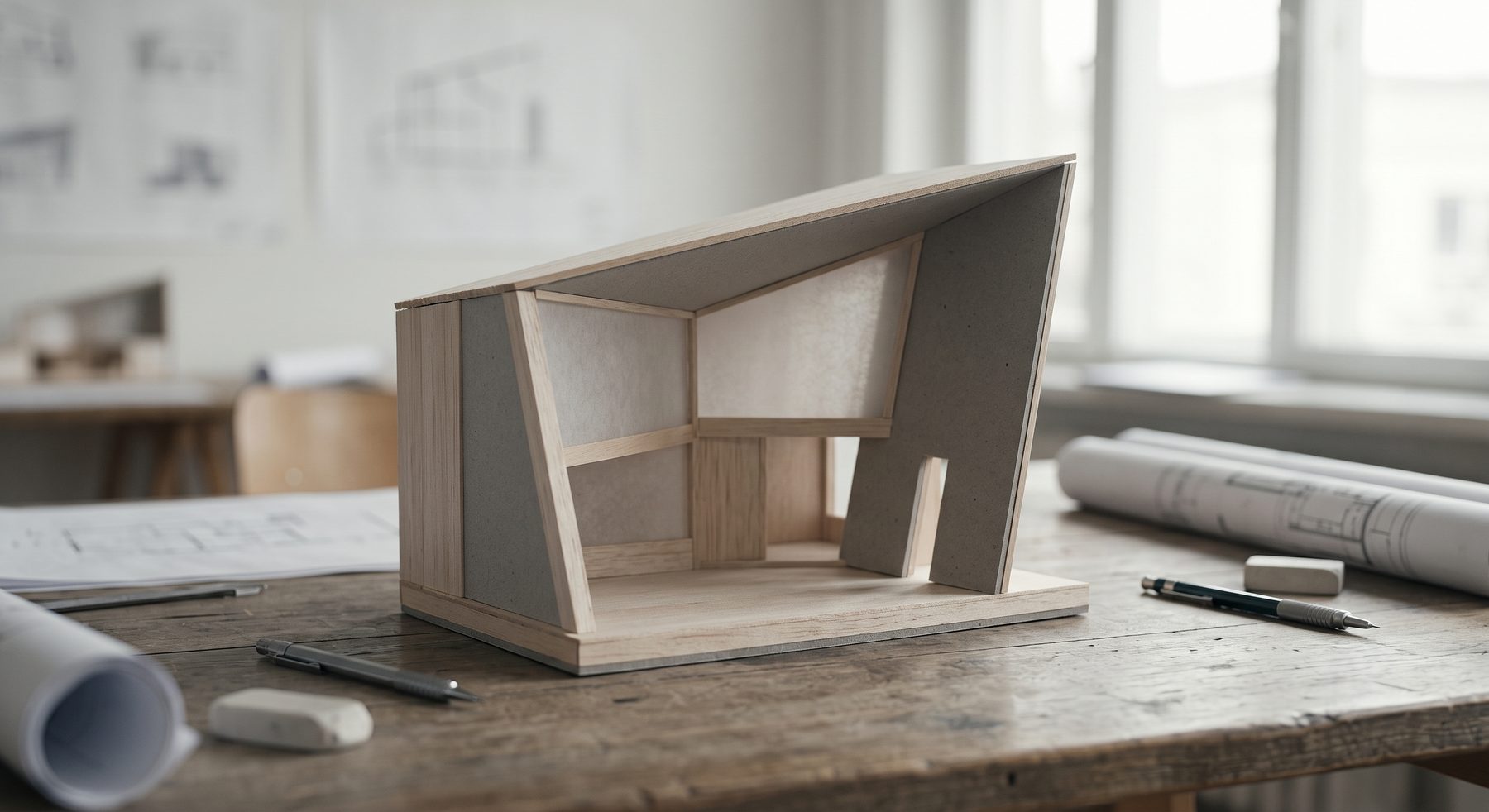
The work therefore proposes a new panning model in which the usable spatial domain itself is deliberately constrained by a trapezoidal envelope. Rather than treating the immersive workspace as an unrestricted cube, rectangle or polar sphere, the model establishes a relationship between elevation and permissible lateral extent.
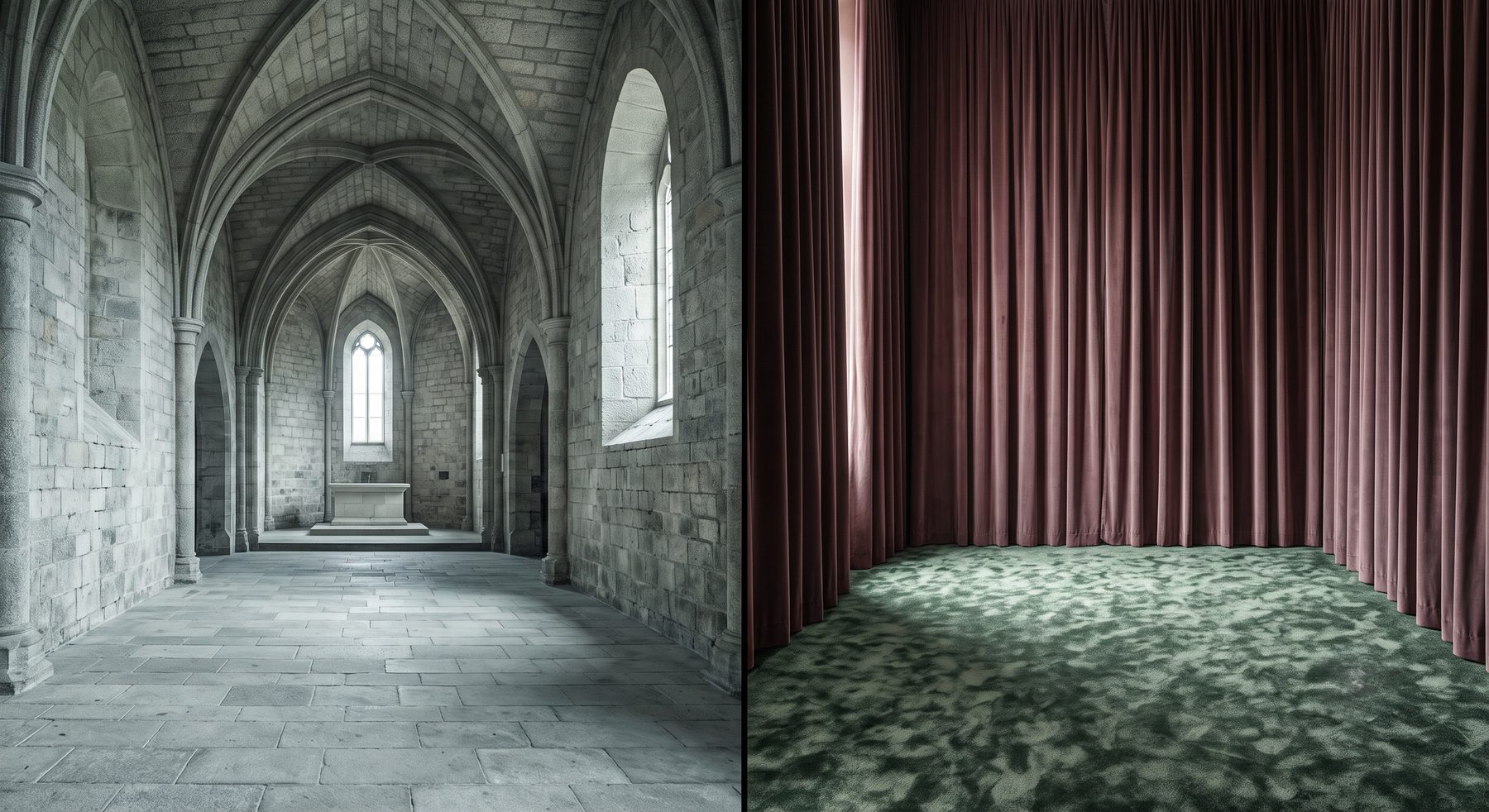
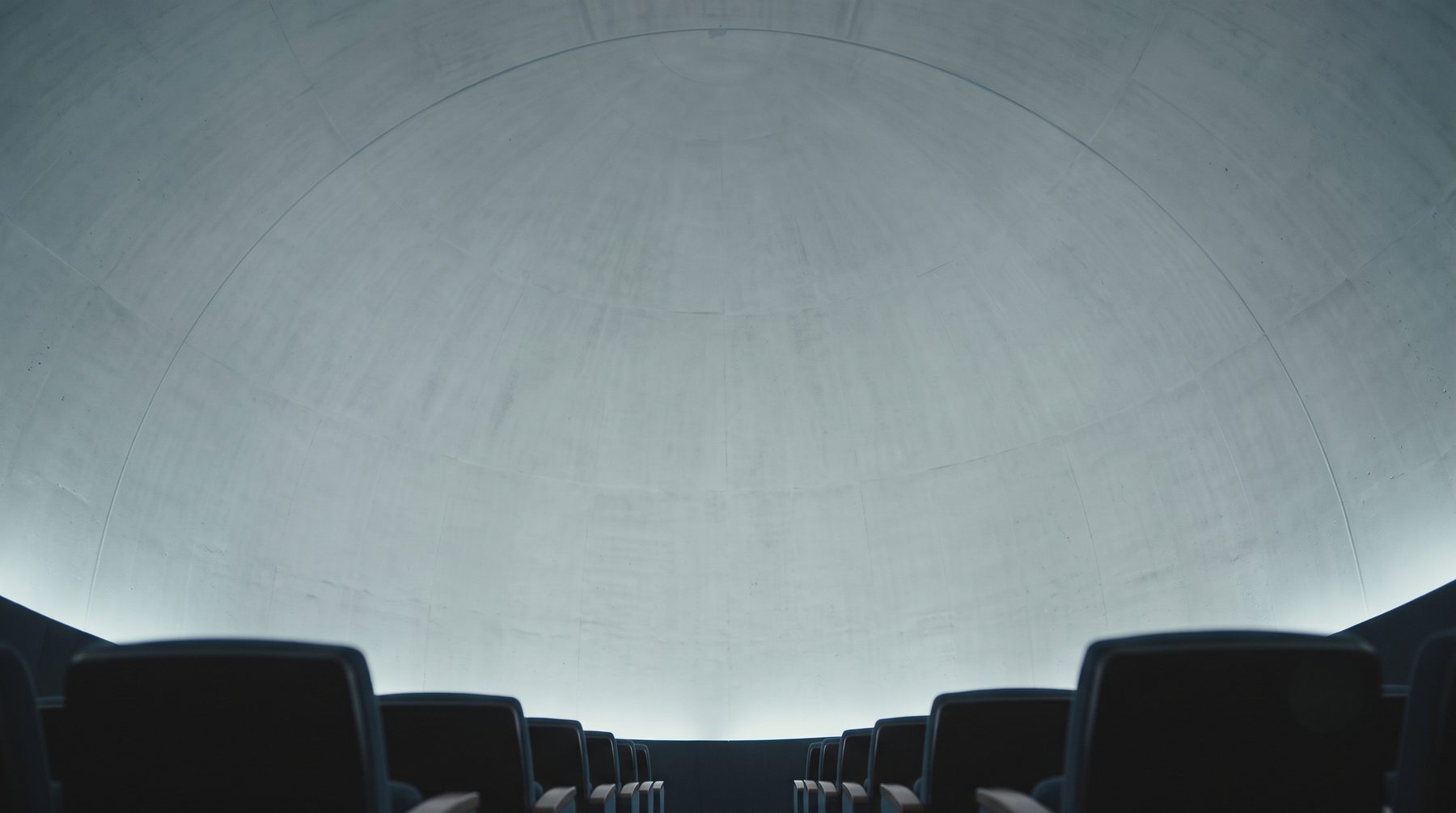
The central proposition is:
A source becoming higher does not inherently mean that it should become wider.
The trapezoidal model is therefore intended not merely as a visual mixing recommendation, but as a general spatial design principle for panning systems in which preservation of spatial intent, translation, topology and perceptual stability are primary objectives.
The broader case study extends this reasoning into loudspeaker topology, human perceptual anisotropy, room acoustics, WFS, LBAP, SPL distribution, reverberation and alternative immersive layouts.
The resulting philosophy is simple:
Do not design the spatial field for the elegance of the coordinate system. Design it for the experience of the listener.
1Introduction: The Seduction of Infinite Space
One of the most exciting things about immersive audio is the apparent disappearance of boundaries.
In stereo, we think in terms of left and right.
In surround, we gain additional directions around the listener.
In immersive reproduction, we gain elevation.
The interface becomes a three-dimensional canvas.
A source can be moved forward, backward, left, right, upward and downward.
The visual result suggests something profound:
there is now a complete three-dimensional world around the listener.
Figure 01
The Seduction of Infinite Space
A field with no edges in sight. The absence of a visible boundary is not the same thing as the absence of a boundary.
Concept illustration, Google Gemini
But the existence of a coordinate does not automatically make that coordinate acoustically or perceptually desirable.
This is the starting point of this work.
The question is not:
“Can the renderer mathematically place a sound there?”
The more important question is:
“What happens to the spatial meaning of the sound when it is placed there and then translated to a different reproduction system?”
That distinction is the foundation of the trapezoidal approach.
2A Simple Thought Experiment: The Bird in the Corner
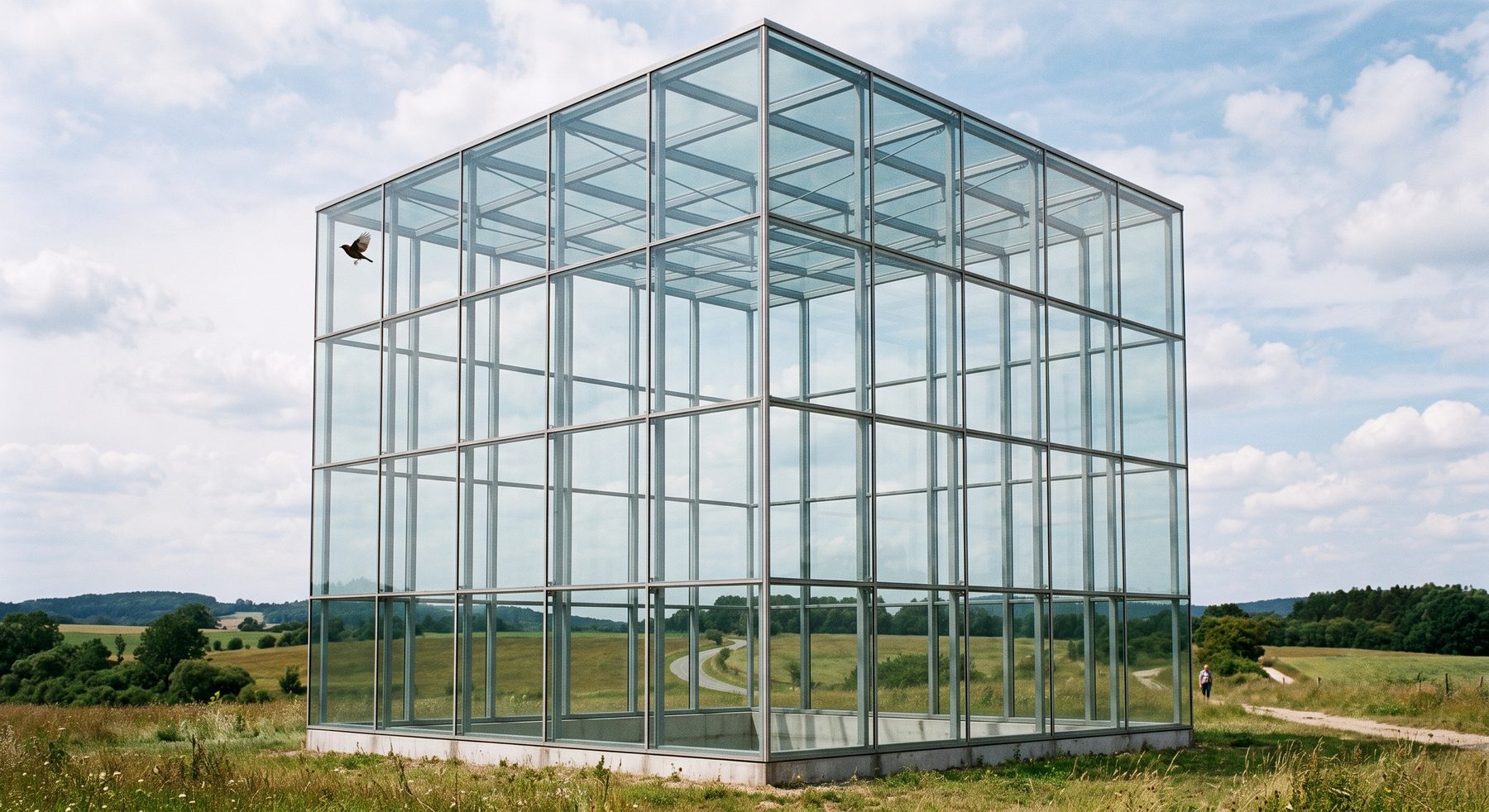
Imagine that you are standing in the middle of an enormous transparent cube.
The cube surrounds you completely.
You can point anywhere inside it and say:
“The sound is there.”
Now imagine a small bird flying into the extreme upper-left corner of that cube.
The bird is:
high above you,
toward your left,
and relatively narrow as a sound source.
Now imagine removing the entire height layer.
The ceiling speakers disappear.
Figure 02
The Bird in the Corner
A source high in the corner of the space. It is high, and it is narrow, and those are two separate facts about it.
Concept illustration, Google Gemini
The bird still exists.
The system now has to represent that elevated source through loudspeakers closer to the horizontal plane.
Here is the important question:
What should happen to the bird's width?
Should it suddenly be pushed out to the extreme left edge of the listening field, far further out than it ever was?
It was never a bird at the edge.
It was simply a high bird.
The same question has a second form for material that has width of its own.
A pair, a spread, a reverberant tail: those do not merely move outward, they grow.
Both are the same failure, and the trapezoid addresses both.
This thought experiment captures the central issue behind the trapezoidal model.
When one spatial dimension disappears, the remaining dimensions should not automatically inherit characteristics that were never part of the original spatial intent.
3Position and Width Are Not the Same Thing
This distinction is surprisingly easy to overlook.
Imagine a single loudspeaker placed two meters to your left.
Now add a second, two meters to your right, and feed the same signal to both.
Both speakers are at the same distance from you as the first one was. But the sound you now hear is not the sound of the first speaker moved: it is a phantom image between the two, and its spatial character is different. 1
Distance is one variable.
Direction is another.
Width is another.
Speaker geometry is another.
Perception combines them.
Therefore:
Speaker radius does not define mix width.
This becomes especially important when elevated content has to be represented through an ear-level system.
A panner must distinguish between:
“How far away is this source?”
and:
“How spatially wide is this source?”
Those are not equivalent questions.
4The Fundamental Problem: Height Should Not Automatically Become Width
Imagine a person speaking from a balcony.
You hear a voice above you.
The voice is elevated.
But you do not automatically perceive the person as two people standing at the extreme left and right edges of the room.
Their elevation and their horizontal extent are separate properties.
Now imagine that the balcony disappears and the audio must be reproduced by a conventional ground-level system.
The challenge is not simply:
Figure 03
What Arrives From Above
The lamps are small. The pools they cast on the floor are not. Something has been added on the way down that was never in the source.
Concept illustration, Google Gemini
“Put the voice somewhere on the ground.”
The real challenge is:
“Represent the elevated voice at ear level without unnecessarily changing its horizontal spatial character.”
This is the problem the trapezoidal model addresses.
The model therefore starts from a simple rule:
Translation should reduce dimensionality without unnecessarily changing spatial intent.
5Existing Bed Behavior Is Context Not the Proposed Contribution
It is important to separate two different ideas.
Traditional channel-based surround architectures have long had specific behaviors arising from their channel structure and downstream redistribution.
A 7.1.2 bed, for example, is fundamentally a channel-based architecture.
When signals are constructed through channels and subsequently folded into another format, the resulting spatial relationships can change.
Certain movement or localization behaviors can therefore become undesirable after translation. 19
That observation is not claimed as the novel discovery in this work.
The existence of such behavior provides the problem context.
The new proposition begins at the next step:
What should the spatial domain of a panner look like if we want to prevent that limitation from defining the spatial behavior of the mix?
That is a different question.
The distinction is essential.
6The Difference Between Describing a Problem and Proposing a Model
Suppose somebody observes that a certain road has a pothole.
That observation is one thing.
Designing a new road surface that prevents vehicles from entering the damaged region is another.
Likewise:
Existing architectural behavior describes what a system does.
A new panning model defines how the spatial problem should instead be structured.
The trapezoidal approach belongs to the second category.
It does not claim ownership over historical bed behavior.
It proposes that the panning domain itself should be constrained so that a known architectural limitation does not become the definition of the object-panning space.
This distinction is central to the novelty of the work.
7From the Cube to the Trapezoid
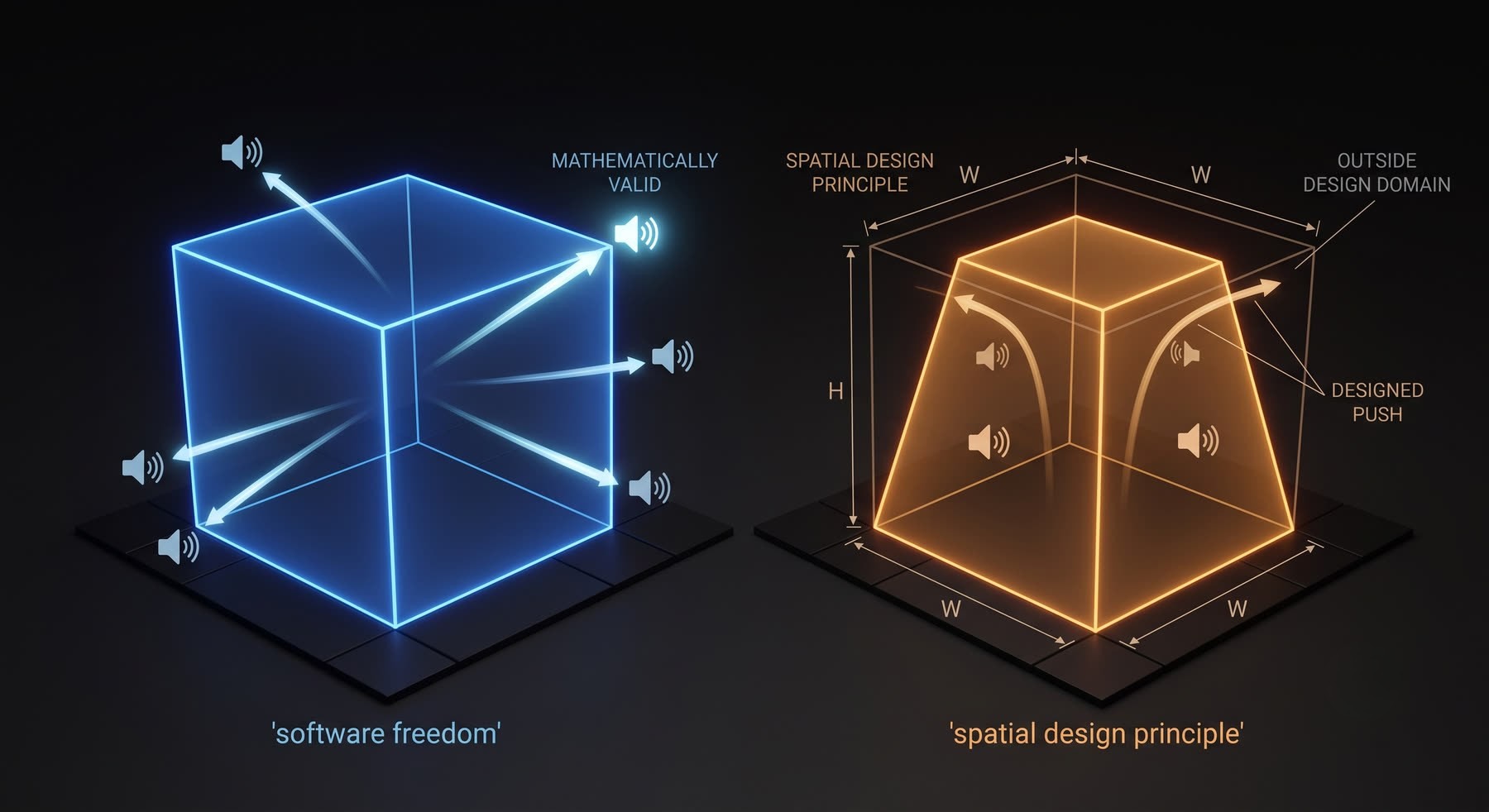
The cube is visually seductive because it appears to provide equal freedom in every direction.
But that equality is an assumption.
A cube effectively says:
“The horizontal freedom at the top of the space is essentially the same as the horizontal freedom at the bottom.”
The trapezoidal model says something different.
It says:
“Allowable lateral extent should change as elevation changes.”
Conceptually, the horizontal envelope becomes a function of height:
W=f(H)
where:
W represents permissible lateral extent,
H represents elevation,
f(H) describes the intended spatial relationship.
The exact geometry can be defined by the implementation.
The important conceptual point is that horizontal freedom is no longer independent of elevation.
This produces a trapezoidal spatial envelope.
8Imagine the Shape as a Beam of Light
Imagine a single lamp set into the ceiling of a room, shining down.
Close to the lamp the beam is narrow.
By the time it reaches the floor it has opened into a broad pool of light.
Now turn that around and read it as a panning space.
At ear level, you have a broad horizontal field.
Figure 04
The Cube and the Trapezoid
Broad at ear level and progressively narrower with height. The purpose is not to remove elevation, but to stop elevation from producing width.
Concept illustration, Google Gemini
As you move upward, the useful region becomes progressively narrower.
Now imagine that the top corners of the conventional cube are no longer part of the useful panning space.
The result is a funnel standing on its wide end, or more simply a trapezoid.
That image is useful because it communicates the underlying concept instantly:
height remains available, but unrestricted width does not.
The purpose is not to remove elevation.
The purpose is to prevent elevation from becoming an unintended mechanism for producing lateral spread.
9Why the Trapezoid Is More Than a “Don't Go There” Diagram
There is an important difference between these two statements:
“Don't use the top corners.”
and:
“The top corners are outside the defined panning domain.”
The first is advice.
The second is a model.
A visual guide depends on the mixer remembering the rule.
A defined spatial model incorporates the rule into the geometry itself.
That is a fundamental shift.
Instead of saying:
“The software lets you go there, but you shouldn't.”
the model says:
“That region is not part of the intended panning envelope.”
This turns the trapezoid from a graphic into a spatial design principle.
10A Simple Everyday Analogy: A Photograph
Imagine that your original mix is a high-resolution photograph.
The immersive master contains more spatial information than some consumer playback systems can reproduce.
Now imagine displaying the same photograph on a smaller screen.
A good scaling process reduces resolution.
It does not move the person in the photograph to the edge simply because the smaller display has fewer pixels.
The picture remains the same.
Figure 05
A Simple Everyday Analogy
The smaller display has fewer pixels to work with. It does not move the subject to the edge in order to make room.
Concept illustration, Google Gemini
Only the available representation changes.
This is a useful analogy for spatial translation.
The goal is not necessarily to preserve every coordinate literally.
The goal is to preserve the composition.
In audio:
Spatial translation should preserve spatial composition, not merely coordinate values.
11Why Polar Geometry Alone Does Not Solve the Problem
Polar representations are powerful tools.
They are intuitive.
They provide elegant angular descriptions.
They are useful for many spatialisation systems.
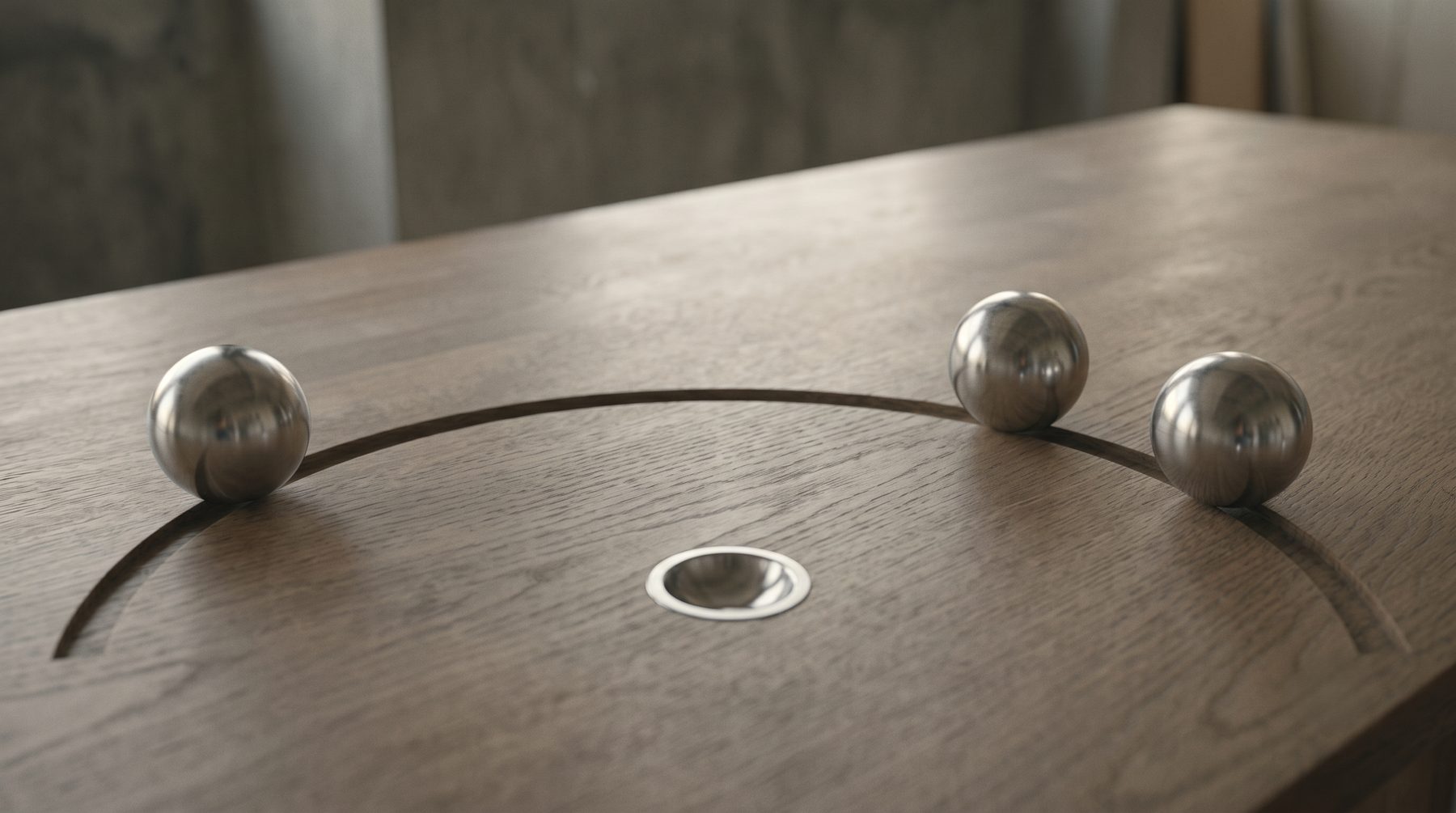
But a fixed radius is not the same thing as fixed perceptual width.
Imagine photographing a person from a fixed distance, first with a wide lens and then with a long one.
The distance has not changed at all.
But the framing has changed completely: in one the person occupies a small part of a broad scene, in the other they fill it.
Figure 06
Everything on the Curve Is on the Curve
Three positions, all of them equally valid as geometry. Geometry alone does not say which of them a listener will accept.
Concept illustration, Google Gemini
The same principle applies to sound.
A source can remain at the same radial distance while the number and placement of active loudspeakers changes its perceived spatial extent.
Therefore:
Fixed Radius ≠ Fixed Width
and:
Angular Symmetry ≠ Perceptual Symmetry
That is why simply expressing the system in polar coordinates does not, by itself, solve the spatial translation problem.
12The Translation Test
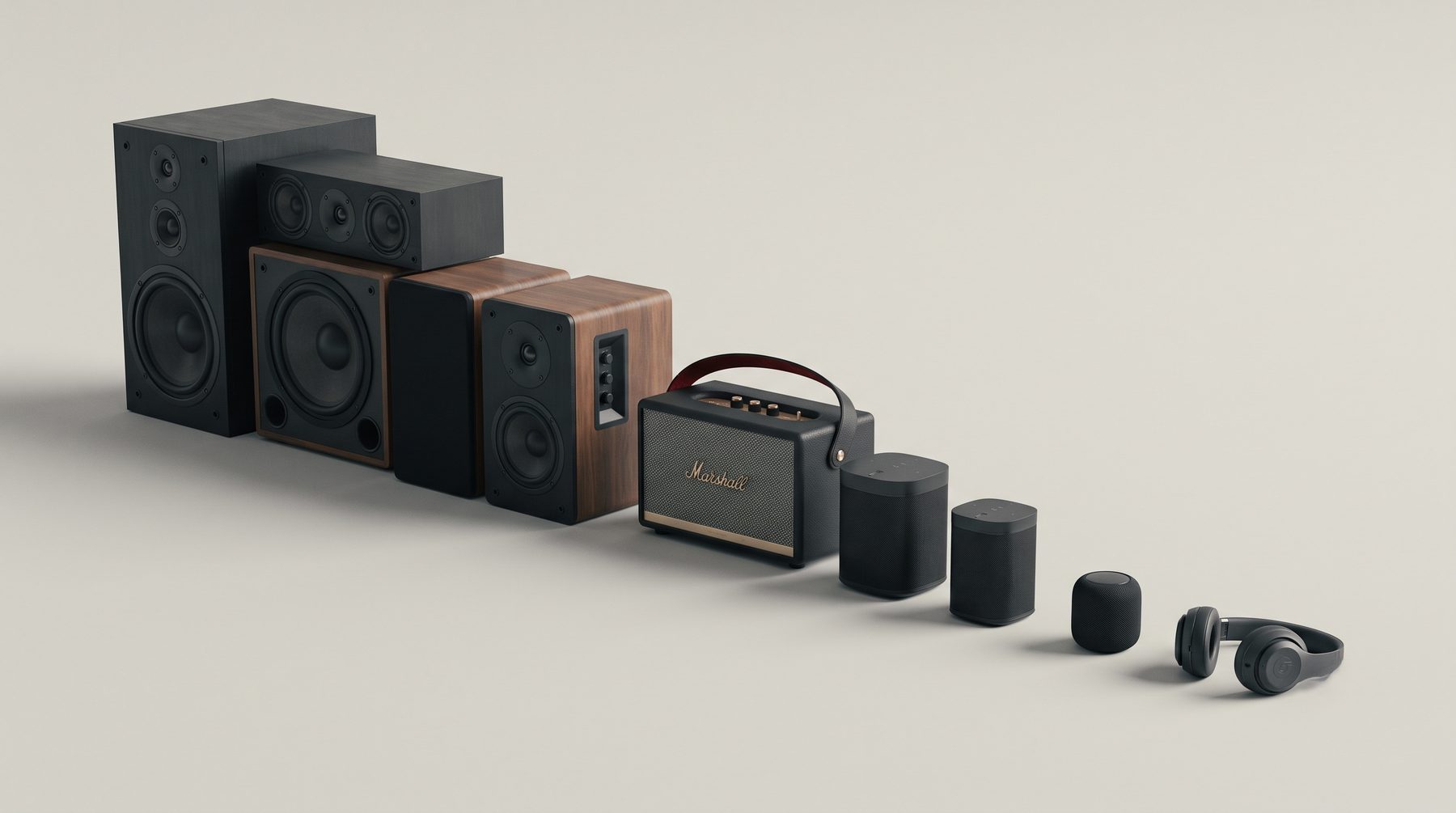
A spatial model should not be judged exclusively by what it does in the most fully equipped reproduction environment.
The stronger test is:
What survives when the reproduction system becomes simpler?
Imagine the same source rendered through:
a full immersive array;
a smaller immersive system;
traditional surround;
stereo;
a soundbar;
a smart speaker.
Every one of those removes some spatial dimensions.
Figure 07
The Translation Test
The same material has to survive every one of these. The largest system is not the one the work will mostly be heard on.
Concept illustration, Google Gemini
Headphones are a separate case, and an instructive one.
A binaural renderer does not lose elevation. It reconstructs it. 1219
Listen
The same object, with and without its height
One bell, placed high and to the left. The first is that placement. The second is the same bell after height has been taken away and nothing else has been reconsidered.
As placed
High and to the left
The bell is above you and off to one side. Both of those are true at once, and neither is doing the other any work.
After the downmix
Lower, and further out
The height is gone, which was unavoidable. What was avoidable is that it has also moved further towards the edge than it ever was.
The examples above are rendered at one reference level, so any difference in loudness you hear is something the panning did, not a mixing choice. Each one loops until you stop it. Headphones, or a pair of stereo speakers you know well.
That makes headphones the destination where the original spatial intent is most nearly available, and the one against which the loudspeaker translations can be judged.
The important question is therefore not:
“Does the source still have the exact same coordinate?”
The question is:
“Does the source still have the same spatial identity?”
That includes perceived width, localization, continuity, placement and relationship to surrounding material.
This is the concept of translation that motivates the trapezoidal model.
13Coordinate Accuracy Versus Intent Accuracy
There are two different ways to define translation accuracy.
Coordinate accuracy
The reproduced position corresponds mathematically to the original position.
Intent accuracy
The reproduced source maintains its intended perceptual relationship to the rest of the mix.
These two objectives can diverge.
A renderer may reproduce a coordinate mathematically while increasing perceived width.
A downmix may preserve overall energy while concentrating too much of it into a smaller number of speakers.
A virtualisation stage may preserve directional indexing while changing the perceived spatial extent.
Therefore the stronger objective is:
Preserve intent while changing topology.
The trapezoidal model is designed around that principle.
14The Human Listener Is Not a Sphere
The geometric argument becomes even more interesting once the listener is considered.
Imagine a perfect mathematical sphere.
Every direction is equivalent.
Rotate it and nothing changes.
Now replace the sphere with a human head.
Immediately the symmetry breaks.
There is a face.
There is a nose.
There are cheeks.
Figure 08
The Human Listener Is Not a Sphere
A sphere is equivalent in every direction. A head is not, and it is the head that does the listening.
Concept illustration, Google Gemini
There are ears.
There are shoulders.
There is a torso.
There is a front and a rear.
The listener is facing a particular direction.
The acoustic boundary condition is no longer rotationally symmetrical.
This is one of the most important ideas in the wider framework of this work:
The coordinate system can be spherical even though the listener is not.
15Human Localization Is Multidimensional
Human localization depends on a combination of cues, including:
interaural time differences;
interaural level differences;
spectral cues;
head and torso diffraction;
pinna filtering;
reflections;
precedence effects;
reverberation;
contextual information;
learned spatial cues.
This means that localization is not determined exclusively by angular position.
The auditory system interprets a complex set of relationships.
A source at one angle is therefore not guaranteed to be perceptually equivalent to another source at an apparently symmetric angle. 710
16Perceptual Anisotropy
This motivates the idea of perceptual anisotropy.
The listener does not have identical localization behavior in every direction. 98
Left and right are strongly related by bilateral symmetry.
Front and rear are not physically identical.
Elevation introduces another set of cues.
Therefore:
Different spatial axes can deserve different design treatment.
That is a powerful departure from the assumption that every point on a sphere deserves equal geometric freedom.
It does not mean symmetry is bad.
It means symmetry should serve the listener rather than define the objective independently of the listener.
17Imagine Turning Your Head
Here is another simple thought experiment.
Imagine hearing a source directly in front of you.
Now imagine turning your head ninety degrees.
Your body and head have changed their relationship to the source.
The acoustic path to the ears has changed.
The spectral filtering has changed.
The binaural relationships have changed.
Now imagine that the same thought experiment happens with a source behind you.
The physical interaction is not simply the mirrored inverse of the front-facing condition.
This is why a mathematically perfect spherical model can still generate perceptually unequal experiences. 11
18Why “More Spherical” Does Not Automatically Mean “More Immersive”
The industry has understandably pursued increasingly spherical and increasingly dense arrays.
There are good engineering reasons for doing so.
A greater number of speakers can provide greater spatial resolution.
A more uniform geometry can simplify modelling.
But more geometry is not automatically more perception.
Imagine a room filled with thousands of tiny lights.
You might assume that adding more lights must automatically produce a better image.
But if they are positioned according to the wrong objective, more lights simply produce a more detailed version of the wrong representation.
Figure 09
More Geometry Is Not More Perception
A greater number of loudspeakers can provide greater spatial resolution. It cannot correct an objective that was set wrongly.
Concept illustration, Google Gemini
The same principle applies to loudspeakers.
Speaker count is not the same thing as spatial quality.
19The Room Is Part of the System
A mathematical coordinate does not exist in free space once the system is installed.
It exists inside a room.
The room contains:
walls,
floor,
ceiling,
furniture,
absorption,
diffusion,
scattering,
reflections,
modal behavior,
reverberation.
These elements affect the acoustic field.
Imagine throwing a ball in an empty field.
Its trajectory is mostly governed by how you throw it.
Now throw the same ball inside a room.
Walls, corners and objects immediately become part of the problem. 14
Sound behaves similarly.
A theoretical source position does not travel through an abstract coordinate system.
It travels through architecture.
20The Panner-to-Room Chain
This suggests that the actual system is closer to:
Object
↓
Spatialisation algorithm
↓
Loudspeaker topology
↓
Acoustic propagation
↓
Room
↓
Listener anatomy
↓
Perception
This is very different from treating the panner as an isolated mathematical tool.
The panner is the first stage of a much larger perceptual chain.
That is why spatial geometry matters.
21The Loudspeaker Topology Is Part of the Algorithm
A panning algorithm does not operate independently from the speakers it drives.
Change the topology and the gain distribution changes.
Change the room and the resulting field changes.
Change the listening position and the perception changes again.
A WFS implementation on one physical geometry can therefore behave differently from another.
Likewise, amplitude-panning systems depend fundamentally on available speaker positions. 161
This leads to an important principle:
Loudspeaker topology is effectively part of spatialisation.
That is why a panning envelope should be designed with its intended physical topology in mind.
22WFS Shows Why Geometry Matters
Wave Field Synthesis is particularly revealing because it is fundamentally concerned with reproducing a sound field over an extended listening area. 56
The physical array is therefore not merely a playback endpoint.
It is part of the wave-field reconstruction mechanism.
In an idealised environment, the geometry may appear beautifully simple.
But a real room introduces:
Figure 10
Why Geometry Matters
Three sources, and a pattern that belongs to none of them alone. What reaches the far edge is the sum, not the intention.
Concept illustration, Google Gemini
reflections,
boundary interactions,
directivity,
absorption,
scattering,
reverberation.
The room becomes an additional component of the system.
This strengthens the broader argument:
A spatial algorithm cannot be judged independently of the physical geometry on which it operates.
23LBAP and the Layered Spatial Domain
Layer-Based Amplitude Panning is worth describing precisely, because its structure is unusually close to the argument of this work. 4
LBAP divides the loudspeakers into horizontal layers according to elevation: a ring at ear level, a ring overhead, and any further rings the room provides.
Azimuth is panned within a layer, using ordinary pairwise amplitude panning between the two neighbouring speakers in that ring.
Elevation is handled separately, by crossfading between the two nearest layers.
Between layers, four loudspeakers are therefore typically active, where three-dimensional vector-based amplitude panning would use three. 12
It is worth being exact about what that produces.
Amplitude panning of any kind creates a phantom image between real sources: the auditory system fuses two or more arrivals into one apparent direction.
It is not a reconstruction of a physical sound field, which is what wave field synthesis in the previous section attempts, and the two should not be described in the same terms.
Like vector-based panning, it also depends on the listening position. Distance-based amplitude panning exists precisely because that dependence is sometimes unacceptable. 3
What makes LBAP relevant here is structural rather than perceptual.
In a layered panner, elevation and azimuth are already separate parameters.
The layer index is elevation. The pan within the layer is azimuth.
A model that makes permissible lateral extent a function of elevation is therefore not an external constraint imposed on such a system. It is a limit on the azimuth range available within each layer, expressed in the terms the algorithm already uses.
That is also how rooms are built. Immersive rigs are installed as rings: one at ear level, one overhead. A layered panner describes the topology as it actually exists, and the trapezoidal envelope becomes a statement about how much azimuth each of those rings should be allowed to use.
The behavior still depends on the geometry of the loudspeakers.
A different topology produces different layers and different gains within them.
The topology therefore becomes inseparable from the final spatial behavior.
24Stable Imaging Versus Geometric Beauty
A system can look unconventional from above and still produce more stable imaging.
This sounds strange only when the diagram is treated as the objective.
Imagine two bridges.
One is perfectly symmetrical and beautiful.
The other looks slightly unusual because the terrain forced the engineers to shape it differently.
Which one is better?
The answer depends on the loads it must carry.
Immersive audio has the same engineering problem.
The question is not:
“Does this topology look perfect?”
It is:
“Does this topology create the desired acoustic and perceptual result?”
25The Reverberation Problem
Reverberation illustrates another hidden variable.
A reverberant field is not simply a number.
RT60 is useful, but it is not a complete description of how a listener experiences reverberation. 1314
The perception also depends on:
early reflection structure;
directional energy;
temporal density;
spectral decay;
diffusion;
source-to-reverberant balance;
room geometry.
Two rooms can exhibit similar overall decay values and still feel very different spatially.
The same can happen with different speaker topologies.
The reverberant field is therefore part of the spatial identity.
26A Reverberation Thought Experiment
Imagine clapping once in two different rooms.
The measured decay time may be similar.
But in one room you may feel that the decay surrounds you smoothly.
In the other, the reflections may seem to favor particular directions.
Figure 11
A Reverberation Thought Experiment
The same source, placed in each of these, is not the same experience. The room is not a setting applied afterwards.
Concept illustration, Google Gemini
The scalar measurement does not necessarily tell the whole perceptual story. 13
Now imagine replacing the rooms with two different loudspeaker topologies reproducing the same reverberant signal.
The apparent spatial structure can change again.
This is why spatial design should consider the field produced during decay, not merely the scalar decay time.
27SPL Distribution as a Design Variable
Another commonly underestimated variable is SPL distribution.
Equal electrical gain does not necessarily create equal acoustic contribution. 14
Speaker distance can differ.
Directivity can differ.
Elevation can differ.
Boundary interaction can differ.
Reflected energy can differ.
Therefore:
Calibration equality is not necessarily perceptual equality.
Rather than asking only:
“Can I make every speaker measure the same?”
we should also ask:
“What distribution of acoustic energy produces the most stable spatial field?”
That is a deeper design question.
28Why Real Rooms Challenge Ideal Geometry
A theoretical immersive environment often begins from ideal geometry.
A real room begins from architecture.
Most rooms are not spheres.
They are rectangular, trapezoidal, irregular or constrained by construction.
The listener is not a mathematical point.
The room is not an infinitely large free field.
The speakers are not perfectly omnidirectional sources.
This makes the idea of a purely abstract spherical coordinate space increasingly questionable as a universal design objective.
The alternative is not to abandon mathematics.
It is to use mathematics to model the physical reality more intelligently.
29The Trapezoid as a Room-Conscious Idea
This is one reason the trapezoidal concept extends beyond downmixing.
The trapezoid is not only a convenient shape.
It reflects a broader design philosophy:
A useful spatial envelope does not have to mirror the idealised geometry of the coordinate system.
Rooms often have boundaries.
Loudspeaker arrays have boundaries.
Human perception has boundaries.
A panning model can have boundaries too.
The boundary is not necessarily a limitation.
It can be part of the optimization.
30Why the Rear Hemisphere Deserves Separate Consideration
Conventional immersive layouts often attempt to preserve geometric symmetry by placing direct loudspeakers behind the listener.
This is attractive from a diagrammatic perspective.
But the listener's front and rear are not physically equivalent. 119
A rear source interacts with the head and body differently.
That can influence:
spectral coloration,
front/back discrimination,
localization confidence,
apparent proximity,
diffuse-field perception.
This does not mean rear information is unimportant.
The opposite is true.
Rear localization is essential.
The question is simply:
Does rear localization always require a dominant speaker directly behind the listener?
That question is worth exploring.
31A Different Way to Imagine Rear Sound
Imagine standing in a dark room while somebody walks behind you.
You do not necessarily need to hear the person through one loudspeaker directly behind your head to understand that they are behind you.
Your auditory system combines neighbouring directional cues. 11
A spatial reproduction system can potentially exploit similar distributed information.
The rear field can become an emergent property of surrounding loudspeakers rather than a single isolated rear point.
This is one of the broader ideas explored by the alternative topology work associated with this research.
32The Planetarium Paradox
The dome seems like the ultimate immersive architecture.
Everything surrounds the listener.
The geometry is symmetrical.
Every direction appears available.
It looks perfect.
Yet the acoustic reality can be remarkably complicated.
A dome introduces strong geometric relationships between:
Figure 12
The Planetarium Paradox
A dome that can put a point anywhere overhead. Being able to place it everywhere is not the same as it belonging everywhere.
Concept illustration, Google Gemini
source,
surface,
reflection,
listener.
The environment itself becomes part of the sound field.
This leads to the concept I describe as the:
Planetarium Paradox
The more geometrically perfect an immersive environment appears, the easier it can become to overlook the acoustic complexity created by that geometry.
A spherical room can be mathematically beautiful and acoustically complicated at the same time.
The geometry of the panning space therefore becomes extremely important.
If the panning domain allows positions that will predictably create unwanted expansion during translation, the problem begins before the downmix.
The downstream system is simply exposing it.
36The Trapezoidal Constraint
The central proposition can now be defined formally in conceptual terms:
The panning domain should be represented as a trapezoidal spatial envelope in which permissible lateral extent is constrained as a function of elevation.
This has several consequences.
Elevation remains available
The model does not eliminate height.
Width remains controlled
Height does not automatically produce unrestricted lateral expansion.
Translation becomes more predictable
The source remains inside a defined spatial envelope.
Topology becomes explicit
The panning space is designed in relation to the physical reproduction architecture.
Intent becomes the objective
The model is designed to preserve spatial character rather than merely mathematical coordinates.
37The Corner Becomes a Design Boundary
The upper corner of the conventional cube is therefore significant.
It represents the simultaneous combination of:
maximum elevation + maximum lateral extent
That combination may be mathematically valid while being undesirable for translation.
The trapezoid deliberately removes that region from the useful panning envelope.
This does not mean:
“The software is broken.”
It means:
“The panning model has defined a more appropriate spatial boundary.”
That is a fundamentally different proposition.
38A Second Thought Experiment: The Balcony
Imagine a theatre.
A singer stands on the stage.
A second singer stands on a balcony.
The balcony singer is above the first.
But neither singer automatically becomes wider because of elevation.
Now imagine that the balcony disappears from the reproduction system.
Figure 21
A Second Thought Experiment
The voice arrives from above. Nothing about its elevation makes it a wider source.
Concept illustration, Google Gemini
The challenge is to preserve the distinction between:
higher
and
wider.
That is exactly the relationship the trapezoidal envelope attempts to protect.
39Why the Sloped Boundary Matters
If the panning region were simply a rectangle, then the system would effectively allow the same horizontal extent at every elevation.
That recreates the assumption that vertical position and horizontal freedom are independent.
The sloped boundaries deliberately reject that assumption.
They encode:
Figure 15
Why the Way Down Matters
It has come to rest. Where it came to rest depends entirely on the path it took to get there, and the path is the part that gets designed.
Concept illustration, Google Gemini
Listen
What happens to a wide element on the way down
A pair of bells with reverb, placed high and spread. Then two different ways of bringing that pair down to ear level. The first example is the intent. Judge the other two against it, and listen to the space between the two bells rather than to either one of them.
As placed
The intent
A pair overhead, comfortably apart. This is the width the mix was made with and the width every other version should be trying to preserve.
A rounded windowA rectangular window
Following the boundary down
Wider than it was
The pair ends up spanning more than it was given, and it comes back louder as well, which quietly moves it forward in the balance against everything it was mixed against. Part of that is the panning. The rest is where the material now sits: energy arriving from the side reaches one side of the head far more strongly than the other, while a source overhead arrives at both ears much more evenly, so the same material reads louder once it has been pushed out to the edge. Two windows arrive here by two routes: the rounded one lets the pair drift apart on the way down, and the rectangular one never made it narrow in the first place.
A trapezoidal window
The trapezoidal result
The width it started with
Everything else is close to where it was. The pair comes straight down and stops short of the side speakers rather than being pushed onto them, and it stays nearer the level it was given, so it is not quietly promoted against the rest of the mix on the way. Compare this against the first example rather than the second.
The examples above are rendered at one reference level, so any difference in loudness you hear is something the panning did, not a mixing choice. Each one loops until you stop it. Headphones, or a pair of stereo speakers you know well.
As the source rises, its maximum permissible lateral extent is reduced.
This makes the boundary itself part of the spatial model.
The trapezoid is therefore not arbitrary decoration.
The slope communicates the relationship between spatial dimensions.
40A Third Thought Experiment: The Window
Imagine looking through a window.
At ground level, perhaps the window opens to a very wide landscape.
As the window rises into an architectural overhang, the visible horizontal field becomes narrower.
Nothing magical happened to the landscape.
Figure 16
A Third Thought Experiment
The opening is small and the view through it is not. A narrow aperture does not make what arrives through it narrow.
Concept illustration, Google Gemini
The available field changed.
That is a useful analogy for the trapezoidal model.
The immersive coordinate system may theoretically contain a huge space.
But the useful panning domain can be deliberately narrower.
41Why This Is a Model, Not Merely a Mixing Tip
Consider the difference between these statements:
Mixing tip: “Stay away from the upper corners.”
Panning model: “The allowable spatial field has a height-dependent lateral boundary.”
Figure 17
A Model, Not a Repair
A patch addresses the hole in front of it. It does not say anything about the next one.
Concept illustration, Google Gemini
The first helps a mixer use an existing system.
The second proposes a way the system itself can be designed.
The second is the conceptual contribution represented by this work.
42Object Panning and the Question of Spatial Freedom
Object-based rendering makes this especially significant.
An object renderer has the conceptual ability to define a source position independently of fixed channel feeds. 171819
That means the panning domain itself can become an explicit design decision.
The question is no longer merely:
“How should this bed channel behave?”
It becomes:
“What is the valid spatial domain in which an object should exist?”
That is a fundamentally different design problem.
The trapezoidal approach addresses that problem directly.
43Separating Architecture From Model
This separation can be illustrated simply.
Existing architecture
A traditional bed has defined channels.
Those channels create established relationships.
Those relationships can generate known downstream behavior.
Proposed model
Figure 18
Separating Architecture From Model
The drawing is not the building and the building is not the drawing. Confusing the two is how a good idea gets judged by the wrong criteria.
Concept illustration, Google Gemini
A panning system defines an independent spatial envelope.
The envelope is deliberately shaped.
The renderer operates inside that envelope.
The resulting geometry no longer needs to inherit every limitation of the historical channel architecture.
The two concepts should therefore not be conflated.
44The Broader Topology Research
The trapezoidal panning concept also belongs to a broader investigation into alternative immersive loudspeaker topologies.
That work explores whether immersive systems should always strive toward perfect spherical symmetry.
Possible objectives include:
more stable imaging;
more predictable spatial trajectories;
more useful SPL distribution;
improved reverberant integration;
better interaction with WFS and LBAP;
reduced front/back ambiguity;
controlled rear-field construction;
better compatibility with real-room acoustics;
improved correlation between binaural simulations and loudspeaker reproduction. 12
These questions move the discussion beyond speaker placement.
They move it toward spatial architecture.
45From Speaker Placement to Spatial Architecture
A speaker layout should therefore not be viewed simply as a set of coordinates.
It is part of an entire system:
Geometry
→ determines
Speaker excitation
→ creates
Acoustic propagation
→ interacts with
Room boundaries
→ produces
Binaural cues
→ becomes
Perception
Changing the first stage can therefore change the entire chain.
This is why topology is not merely a hardware decision.
It is a spatial-rendering decision.
46Why Symmetry Still Matters
None of this is an argument against symmetry.
Symmetry is extremely valuable.
It provides:
design simplicity;
easier calibration;
repeatability;
manufacturing consistency;
predictable mathematical behavior.
Bilateral left/right symmetry is also particularly meaningful because the human auditory system itself exhibits strong bilateral symmetry.
The argument is more nuanced:
Symmetry is a tool. It should not automatically become the objective.
The correct question is:
“Where does symmetry help the listener?”
rather than:
“How can we make everything symmetrical?”
47Deliberate Asymmetry
If human perception is anisotropic and rooms are not spherical, then deliberately introducing asymmetry may sometimes be useful.
An immersive system might therefore:
allocate more spatial resolution to some directions;
reduce direct energy from certain positions;
change speaker density across axes;
treat elevation differently from azimuth;
constrain panning freedom according to height;
use neighbouring speakers to construct a rear field.
Figure 19
Deliberate Asymmetry
Nothing here is evenly spaced, and nothing here is accidental. Even distribution and considered distribution are different objectives.
Concept illustration, Google Gemini
That does not make the system defective.
It means the topology is being designed around the physical problem.
48Perceptual Resolution Rather Than Uniform Resolution
Imagine the human eye.
Its resolution is not uniform: it is dense at the center of gaze and much coarser at the edges.
Virtual reality headsets exploit this directly, spending rendering effort where the eye is looking and saving it everywhere else.
The display is not worse for being non-uniform. It is matched to the observer.
Similarly, an immersive system does not necessarily need identical spatial resolution in every direction. 89
If listeners are more sensitive to certain directional differences than others, spatial resources can be allocated accordingly.
The question becomes:
Where does additional spatial resolution actually produce a meaningful perceptual benefit?
That is a much more productive design question than simply maximizing speaker density.
49A More Useful Definition of Immersion
Perhaps this also suggests a better definition of immersion.
Immersion is not necessarily:
“sound exists at every mathematically possible position.”
Immersion may be better described as:
“the listener experiences a coherent and convincing spatial field whose relationships remain stable as sources move through it.”
Under this definition, stability and continuity become more important than geometric completeness.
That is precisely where the trapezoidal philosophy becomes relevant.
50The Translation-First Principle
A practical design principle follows:
Design the native spatial field with translation in mind from the beginning.
Do not wait until the downmix stage to discover that certain positions produce unwanted expansion.
Do not create a spatial field first and ask another system to repair it later.
Instead:
define the spatial envelope;
define the relationship between elevation and width;
render within that envelope;
evaluate translation;
validate the perceptual result.
This turns translation from a compatibility problem into a design criterion.
51The “Real Room” Test
A useful conceptual test is simple:
Imagine the system installed in an actual room.
Now ask:
Figure 20
The Real Room Test
This is where the work is actually heard. It was not designed for listening and it does not care what it was mixed on.
Concept illustration, Google Gemini
What happens if the listener is not perfectly centered?
What happens when the room adds reflections?
What happens to reverberation?
What happens when the playback system has fewer speakers?
What happens when height disappears?
What happens to width?
What happens to rear localization?
What happens to image stability?
If a model only works in the diagram, it is incomplete.
The real room is the ultimate test.
52The Listener Is the Final Measurement Instrument
This is the larger framework within which the trapezoidal approach should be understood.
53What the Trapezoidal Model Is Actually Solving
At the most practical level, the model addresses one central problem:
How can a panning system represent elevated content without allowing the loss of elevation during translation to unnecessarily alter its horizontal spatial character?
The proposed solution is:
Constrain the panning space so that lateral extent becomes dependent on elevation.
That is the essential idea.
Everything else in the larger research framework supports why such a constraint can be useful.
54What the Model Is Not Claiming
The model does not claim:
that traditional channel-based bed behavior was invented here;
that every immersive system is fundamentally flawed;
that spherical layouts have no legitimate applications;
that polar mathematics is useless;
that height should be removed;
that rear information is unimportant;
that symmetry should be abandoned;
that measurement is inadequate.
The proposition is narrower and more precise.
It argues that:
the spatial panning domain itself can be intentionally shaped to better preserve spatial intent across reproduction conditions.
55What Makes the Contribution Distinct
The contribution described in this publication lies in the combination of the following proposition:
Define a spatial envelope independently of the historical limitations of a channel-based bed.
Make that envelope trapezoidal rather than unrestricted.
Tie lateral freedom to elevation.
Use the envelope as a panning constraint rather than merely as a visual reminder.
Treat the constraint as part of a translation-oriented spatial model.
This transforms the trapezoid from a diagram into a formal conceptual framework.
56A Simple Mental Model for a Mixer
For practical use, the entire concept can be remembered with one sentence:
“Do not ask how far into the corner I can place the object; ask how much horizontal width the object should be allowed to have at that height.”
That single change in thinking can fundamentally alter how the immersive workspace is approached.
The coordinate system stops being a playground.
It becomes a controlled spatial environment.
57A Mixer-Friendly Visualisation
Imagine the conventional immersive space as a large rectangle.
Now imagine drawing two diagonal lines from the bottom outer edges toward a narrower upper region.
The resulting trapezoid is your useful spatial field.
Within it, elevation remains available.
Outside it, the system is effectively saying:
“You are now asking elevation to coexist with more horizontal spread than the translation model is designed to preserve.”
The visualisation is simple.
The underlying design principle is not.
58Another Everyday Example: A Mountain Road
Imagine driving up a mountain.
At the bottom, the road is wide.
Higher up, the terrain becomes narrower.
You would not describe the narrowing road as a failure of the mountain.
The road is simply responding to the geometry of the environment.
The trapezoidal model follows the same engineering philosophy.
Figure 22
Another Everyday Example
The road narrows as the terrain rises. Nobody describes that as a failure of the mountain.
Concept illustration, Google Gemini
Instead of assuming:
“Every height should have the same horizontal freedom,”
it says:
“The useful spatial domain should adapt to the dimensional relationship of the system.”
59Why the Name “Trapezoidal” Matters
The name describes more than a shape.
It identifies the defining property of the model:
the lateral boundaries are not parallel.
That matters because the spatial field is intentionally not uniform with elevation.
The shape therefore acts as a compact representation of the underlying design philosophy.
A single word communicates:
constrained lateral freedom,
elevation-dependent geometry,
spatial envelope,
non-uniform panning domain.
This makes the concept easier to discuss, reproduce and research.
60From a Mixing Concept to a Research Framework
The trapezoidal model can therefore be viewed at several levels.
At the mixer level
It is a way of thinking about where to place objects.
At the panner level
It is a geometric restriction on the usable spatial domain.
At the renderer level
It is a topology-aware definition of the spatial field.
At the system level
It is a translation-oriented spatial architecture.
At the research level
It is a proposal that perceptual objectives should determine spatial geometry rather than the other way around.
These are different layers of the same idea.
61Beyond Dolby: The Broader Question
The concept should therefore not be reduced to the behavior of one renderer or one ecosystem. 151619
The deeper question is general:
How should a three-dimensional panning system be designed when the destination may not have three independent spatial dimensions?
This applies to any situation in which richer spatial information is ultimately reproduced by a simpler geometry.
That includes:
immersive-to-surround translation;
immersive-to-stereo translation;
loudspeaker virtualisation;
smart-speaker reproduction;
soundbar systems;
binaural rendering;
topology-dependent object rendering.
The general challenge remains the same:
preserve spatial intent while dimensions disappear.
62A More General Definition of Spatial Fidelity
Spatial fidelity should therefore not mean merely:
“The renderer reproduced the original coordinate.”
It should mean:
“The renderer preserved the meaningful spatial relationships of the original source as closely as the destination topology permits.”
This is a more useful engineering definition.
It acknowledges that reproduction systems are not identical.
It acknowledges that dimensionality can change.
And it acknowledges that a listener perceives relationships rather than mathematical coordinates.
63The Future May Not Be Spherical
The future of immersive audio may still contain spherical systems.
It may contain very dense arrays.
It may contain domes.
It may contain completely different topologies.
The point is not to predict one winner.
Figure 23
The Future May Not Be Spherical
A form that rises without ever being a sphere. Uniformity in every direction is one answer to the problem, and it is not the only one.
Concept illustration, Google Gemini
The point is to challenge the assumption that increasing geometric symmetry is always the endpoint.
The next generation of spatial systems may instead optimize for:
perceptual continuity;
topology awareness;
translation;
room interaction;
SPL distribution;
human anatomy;
spatial stability.
That could lead to geometries that are intentionally less symmetrical but more perceptually purposeful.
64From Geometry to Perception
The broader design philosophy can now be stated:
Geometry is the means. Perception is the objective.
A beautiful geometry is useful when it helps perception.
A symmetrical geometry is useful when symmetry helps perception.
A spherical geometry is useful when spherical distribution helps perception.
But none of those properties is inherently the objective.
The listener is the objective.
65The Core Proposition, One More Time
Everything in this case study ultimately returns to one principle:
A panning system should not automatically convert vertical position into increased horizontal width when translating between reproduction dimensions.
The trapezoidal model addresses this by defining a spatial envelope in which:
W=f(H)
rather than:
W = constant independent of H
The result is a spatial domain that deliberately becomes more restrictive as elevation increases.
That is the geometric heart of the model.
66Why the Model Matters Beyond One Downmix
It would be a mistake to think of the trapezoid merely as a solution to one particular fold-down problem.
The broader significance is that it demonstrates a new way to think about panning.
Instead of beginning with:
“What coordinate system should I use?”
begin with:
“What spatial behavior should the coordinate system enforce?”
That reverses the traditional design order.
The model begins with the perceptual objective and constructs the spatial domain around it.
67The Larger Design Philosophy
The overall philosophy behind this work can therefore be summarised as:
Do not design the loudspeaker topology solely around mathematical symmetry.
Do not design the panning space solely around software freedom.
Do not judge translation solely by coordinate correspondence.
Do not evaluate rooms solely through one scalar metric.
Do not assume the listener is geometrically isotropic.
Instead:
Design the spatial system around the behavior you want a human listener to experience.
68Research Directions
The model naturally leads to further questions.
Can the trapezoidal envelope be optimized mathematically for different room sizes?
Can different slopes provide better translation?
Can the same principle be adapted to alternative topologies?
Can spatial density be varied according to perceptual sensitivity?
Can rear information be reconstructed through distributed fields rather than direct rear sources?
Can WFS implementations be optimized specifically for enclosed rooms?
Can reverberant objects be evaluated using spatial decay metrics rather than scalar RT60 alone?
Can binaural simulation be correlated more directly with physical loudspeaker reproduction?
These questions extend beyond the initial panning model.
They point toward a broader field of topology-aware spatial rendering.
69Case Study Summary
The research presented here can therefore be reduced to five observations.
Observation 1
A mathematically available position is not automatically a perceptually appropriate position.
Observation 2
Speaker radius and perceived width are different variables.
Observation 3
Height does not intrinsically imply horizontal expansion.
Observation 4
Human perception and real-room acoustics are not geometrically isotropic.
Observation 5
Therefore, the panning domain itself can legitimately become an optimization variable.
The trapezoidal model is the practical expression of those observations.
70Final Thought Experiment: The Map
Imagine being given a map of an unfamiliar city.
The map may theoretically contain every street.
But a navigation system does not necessarily treat every street as equally useful.
Some are too narrow.
Some are blocked.
Some are unsafe.
Some lead nowhere.
A good navigation system therefore does not merely display geography.
Figure 24
Final Thought Experiment
Every map is a decision about what to keep. A map that kept everything would be the territory, and would be no use to anyone.
Concept illustration, Google Gemini
It interprets geography.
A panner can be thought of in the same way.
The coordinate system is the map.
The trapezoidal envelope is the routing logic.
The objective is not to prove that every possible coordinate exists.
The objective is to guide the signal through the spatial paths that best preserve its intended destination.
71Conclusion
Immersive audio has given us an extraordinary amount of geometric freedom.
But freedom and accuracy are not the same thing.
A spatial renderer may offer a cube.
A mathematical model may offer a sphere.
A polar interface may offer every possible angle.
None of these, by themselves, guarantee that the listener will experience the intended spatial result.
The trapezoidal approach begins from a different premise.
The useful panning space should be designed, not merely exposed.
Elevation should not automatically create width.
A lower-dimensional translation should not unnecessarily rewrite the spatial composition of the original.
The panner should be considered part of a larger system that includes:
topology → room → listener → perception.
The purpose of the trapezoid is therefore not to make immersive audio less capable.
It is to make spatial freedom more meaningful.
The model proposes that the panning domain itself can be shaped according to a defined perceptual and translational objective.
The wider research associated with this work extends the same philosophy into loudspeaker topology, WFS, LBAP, room interaction, reverberation, SPL distribution and human perceptual anisotropy.
The conclusion is therefore broader than one panning interface.
It is a design principle:
Do not design the sound field around the geometry of the diagram.
Design the geometry around the sound field you want the human being to perceive.
The sphere is beautiful.
The circle is elegant.
Symmetry is powerful.
But humans are not spheres.
Rooms are not free fields.
And perception is not a polar coordinate system.
The next step in immersive audio may therefore not be to make the reproduction space more geometrically perfect.
It may be to make it more perceptually purposeful.
REFERENCES
The following works are referenced in this case study. They are cited to identify prior art, established measurement and existing standards, and to make explicit which of the material discussed here is the contribution of others.
Layer-Based Amplitude Panning is described in implementation documentation rather than in a founding publication. No canonical authorship exists for it, and none is asserted here.
Reference 20 is the author's own earlier publication of this material.
Lossius, T., Baltazar, P., and de la Hogue, T. "DBAP - Distance-Based Amplitude Panning."Proceedings of the International Computer Music Conference (ICMC 2009), Montreal, 2009. Amplitude panning. Section 23.
FLUX:: and IRCAM. "Panning Algorithms." SPAT Revolution documentation. Layer-Based Amplitude Panning, described as layered two-dimensional vector-based panning. Section 23.
Berkhout, A. J. "A Holographic Approach to Acoustic Control."Journal of the Audio Engineering Society, vol. 36, no. 12, pp. 977-995, December 1988. Wave Field Synthesis. Sections 22, 44.
Berkhout, A. J., de Vries, D., and Vogel, P. "Acoustic control by wave field synthesis."Journal of the Acoustical Society of America, vol. 93, no. 5, pp. 2764-2778, May 1993. Wave Field Synthesis. Sections 22, 44.
Mills, A. W. "On the Minimum Audible Angle."Journal of the Acoustical Society of America, vol. 30, no. 4, pp. 237-246, 1958. Angular acuity is not constant with direction. Sections 16, 48.
Makous, J. C., and Middlebrooks, J. C. "Two-dimensional sound localization by human listeners."Journal of the Acoustical Society of America, vol. 87, no. 5, pp. 2188-2200, May 1990. Localization measured across azimuth and elevation together. Sections 16, 48.
Litovsky, R. Y., Colburn, H. S., Yost, W. A., and Guzman, S. J. "The precedence effect."Journal of the Acoustical Society of America, vol. 106, no. 4, pp. 1633-1654, October 1999. Precedence. Section 15.
Recommendation ITU-R BS.2051-3. Advanced sound system for programme production. International Telecommunication Union, Geneva, May 2022. Immersive loudspeaker layouts. Sections 21, 61.
Recommendation ITU-R BS.2076-3. Audio Definition Model. International Telecommunication Union, Geneva, February 2025. Object-based delivery. Sections 35, 42.
SMPTE ST 2098-2:2022. Immersive Audio Bitstream Specification. Society of Motion Picture and Television Engineers, 2022. Object-based delivery. Sections 35, 42.
Dolby Laboratories. Dolby Atmos Renderer, version 5.3.2, and the accompanying Renderer Guide. Dolby Laboratories, Inc. Renderer behavior described in this work was observed in this version. Sections 5, 12, 42, 61.
This article, including its text, structure, figures, terminology, analytical framework and original conceptual formulations, is an original work of authorship by Poorna Srikar Maremanda.
The work includes the conceptual formulation of the Trapezoidal Panning approach presented in this publication, together with the associated framework concerning spatial translation, perceptual anisotropy, topology-aware panning, spatial envelopes and the term “Planetarium Paradox.”
Attribution is required for reproduction of the work in whole or substantial part, republication, translation, incorporation of substantial text or figures into product documentation, incorporation into commercial training or marketing material, or preparation of derivative publications based substantially upon this work.
Permitted use
Readers may read, reference, quote and cite this work for research, teaching, review, commentary and journalism, provided that attribution is made to:
Poorna Srikar Maremanda
and the original publication is clearly identified and linked.
Implementation
The Trapezoidal Panning approach, together with implementation-specific geometry, verified coordinate sets, tuned pan law, reference renders and associated testing material developed as part of this work, constitutes the author's documented implementation and research material.
Commercial software, hardware, research prototypes and public installations implementing this work should be discussed with the author before release.
Where implemented under an appropriate license agreement, requested attribution is:
Verified coordinate sets, tuned parameters, reference renders and test materials may be supplied to implementers under an appropriate written license agreement.
This work does not claim that every established immersive system is incorrect.
It makes a narrower and more fundamental proposition:
The mathematically available spatial domain should not automatically be assumed to be the perceptually correct spatial domain.
The trapezoidal approach is an attempt to formalise that distinction.
A panner should not merely answer:
“Where can sound exist?”
It should also answer:
“Where should sound exist if the objective is to preserve its spatial meaning?”
That is the question at the center of this work.
First publication
First published on as
Mastering Atmos Panning: The Common "Corner" Mistake and the Trapezoid Solution. This page is the expanded case study and the version of
record, version 1.0.
Archived with a permanent identifier at
doi.org/10.5281/zenodo.22768669,
and published under the Creative Commons licence set out in the notice of rights above.
How to cite this work
Maremanda, Poorna Srikar. "BEYOND THE SPHERE: A Case Study in Trapezoidal Panning, Spatial Translation and Perceptually Optimized Immersive Audio." First published 8 December 2025. Expanded case study, iammps Knowledge Centre. https://iammps.com/knowledge-centre/beyond-the-sphere https://doi.org/10.5281/zenodo.22768669
Attribution to Poorna Srikar Maremanda and a clear link to this page are required
for quotation, reference and citation. Terms are set out in the notice of rights above.
IAMMPS™ and its products are backed by Intellectual Property Rights filings with the Office of the Controller General of Patents, Designs and Trade Marks, India.